

Field notes
Republic of Altis and Stratis
The sovereign state encompassing Altis and Stratis, and the central state actor in the Poseidon Crisis.
Overview
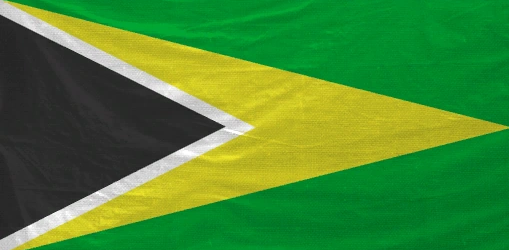
The Republic of Altis and Stratis is the sovereign state encompassing the islands of Altis and Stratis. Its capital is Pyrgos, and within the broader ArmA setting it is presented as a Mediterranean island country with its own government, institutions, and national identity. In the War is Hell setting, it is the primary state actor at the center of the Poseidon Crisis, caught between deep domestic instability, growing foreign pressure, and the strategic consequences of the discovery of the Poseidon Reserve.
Though formally recognized as an independent republic, the state entered the 2020s in a fragile condition. Economic decline, political dysfunction, and growing public distrust weakened civilian institutions well before the crisis entered its open phase in 2025. As unrest intensified, the Republic increasingly relied on security and military structures to maintain order, a shift that further strained its legitimacy in the eyes of many citizens.
In War is Hell, this period is intended to supplement the broader ArmA 3 history of the Republic rather than overwrite it. The Poseidon-era crisis is treated as an earlier phase of destabilization that helps lead into the harsher conflicts associated with later official canon.
State Identity
In official and semi-official ArmA canon, the Republic of Altis and Stratis is treated as an island country in the Mediterranean with Pyrgos as its capital, Altian as its demonym, and both English and Altian in public use. It is also associated with its own national currency, represented by the symbol ₳. These details help frame the Republic not merely as a battleground, but as a functioning state with a distinct political and civic identity before the crisis period fully destabilized it.
Within War is Hell, those baseline national details remain useful background for understanding why the struggle over the Republic carries both domestic and international weight.
Geography and Composition
The Republic consists primarily of Altis, its largest and most politically significant island, and Stratis, the smaller island that remains strategically important for military access and regional control. Together they form a state whose value lies not only in population centers and political institutions, but also in coastlines, transport links, airfields, and proximity to the wider eastern Mediterranean.
Because the Republic spans more than one island, pressure on the state is never confined to a single urban center or military front. Political authority, infrastructure security, and military mobility all depend on maintaining control across a dispersed island territory.
Historical Background
In broader ArmA canon, the Republic is the modern political successor to a much longer history of foreign rule, colonial administration, and eventual independence in the late modern era. For the purposes of War is Hell, the most relevant point is that the Republic exists as an established independent state whose institutions predate the Poseidon Crisis by decades.
That background matters because the crisis is not presented as the birth of the Republic, but as a period in which an already recognized state begins to fail under the combined pressure of economic breakdown, internal unrest, and strategic competition.
Political and Economic Conditions
By the time the Discovery of the Poseidon Reserve was announced in June 2024, the Republic was already under severe economic pressure. Inflation, shortages, and failing public services had contributed to widespread frustration, while confidence in the civilian government continued to erode. The reserve was initially seen as a possible turning point, but the lack of immediate relief only widened the gap between public expectations and political reality.
Part of the Republic’s vulnerability lay in the structure of its economy. In line with broader ArmA background lore, Altis and Stratis depended heavily on tourism and associated service activity, leaving the state especially exposed when wider economic conditions deteriorated. As those sectors contracted, the loss of income and employment accelerated public frustration and made recovery more difficult. These conditions are explored in greater detail in the Altian Economic Crisis entry.
As the government struggled to stabilize the country, protests expanded across major urban areas and anti-government sentiment grew more organized. The Republic’s leadership publicly framed its actions as necessary measures for preserving sovereignty and preventing collapse, but opponents increasingly viewed the state as ineffective, repressive, or vulnerable to outside manipulation.
Government and Institutions
The Republic’s civilian government remained the formal center of national authority throughout the buildup to the Poseidon Crisis, but its practical control weakened as conditions deteriorated. Ministries, local administration, and public services continued to function in uneven and increasingly strained ways, especially as shortages and public anger grew.
This weakening of institutional credibility became one of the defining features of the crisis period. The state still claimed legal authority, but its ability to govern effectively depended more and more on security enforcement and the visible presence of the AAF.
Strategic Position
The Republic’s geopolitical importance increased dramatically after the discovery of the Poseidon Reserve. Its position in the eastern Mediterranean, combined with access to offshore energy resources, made it a focal point for outside actors seeking influence over shipping routes, regional power balances, and future energy infrastructure.
This strategic value exposed the Republic to mounting pressure from foreign interests, including covert efforts to influence internal conditions on the islands. In this environment, the Republic was forced to navigate not only domestic unrest but also an increasingly contested regional landscape shaped by actors such as Turkey and the networks linked to The Turk.
State Security and the AAF
The Altis Armed Forces, commonly referred to as the AAF, are the official military of the Republic of Altis and Stratis and serve as its primary instrument of national defense, territorial integrity, and internal security. They became increasingly central to state policy as the civilian government lost the ability to contain unrest through conventional political means alone.
The AAF is organized as a conventional force with ground units, limited naval assets, and air support elements. Its personnel are primarily Altian nationals, many of whom are trained under NATO-aligned doctrine and standards. Despite resource limitations and the effects of long-term economic strain, the AAF remained the most organized and capable institution within the Republic during the buildup to the crisis.
During the early armed phase of the crisis, the force was commanded by Colonel Konstantinos Drakos, a senior infantry officer regarded as one of the republic’s most respected military leaders. His command became symbolically important because he represented an AAF still formally loyal to civilian authority even as pressure mounted from insurgency, institutional decay, and foreign interference.
Internal Security Operations
Following the Discovery of the Poseidon Reserve, the Republic increasingly deployed AAF units in support of internal security operations. These deployments included crowd control, infrastructure protection, patrol operations, and the enforcement of government restrictions in unstable areas. By late 2024, military personnel were routinely visible in key population centers, including Kavala and surrounding regions.
This shift placed the state in direct confrontation with segments of its own population. What the Republic described as necessary stabilization measures were often seen by critics as signs of state overreach, and reports of heavy-handed enforcement further damaged trust in both the government and the military.
After the Destruction of the Northern Radar Installation, internal security operations widened further into direct sweep actions in northwestern Altis. These efforts were intended to deny armed opposition elements a safe haven in the western highlands, but early contact showed how limited the state’s reach had become in difficult rural terrain and how much official assumptions lagged behind battlefield reality.
By April 13, 2025, the Republic’s vulnerability had become even more exposed. While the AAF remained heavily engaged in the west and still trying to understand the scale of the insurgent threat it faced, opposition activity elsewhere helped create the conditions for a much larger breach centered on Molos Airfield. What followed made clear that the state was no longer confronting only internal sabotage and armed unrest, but the consequences of direct foreign intervention on its own territory.
Relationship with Opposition Groups
As the Republic’s authority weakened, decentralized anti-government formations collectively identified as the Altian Opposition Networks began to expand. The government and the AAF viewed these groups as emerging internal threats, though their loose structure made them difficult to track or neutralize.
Early engagements between state forces and opposition elements were sporadic and localized, often taking place in rural or mountainous areas where state presence was weaker. Over time, however, growing coordination, improved access to resources, and suspected foreign support increased the effectiveness of these groups and deepened the Republic’s security crisis.
Foreign Influence
The Republic maintained formal relationships with NATO and European partners, but intelligence and security officials increasingly suspected that select opposition elements were receiving outside support. Although direct proof remained limited, patterns of funding, coordination, and access to weapons suggested that foreign actors were attempting to shape the Republic’s future by destabilizing it from within.
These suspicions became central to how the state understood the emerging crisis. By early 2025, and especially after the Destruction of the Northern Radar Installation, the Republic was no longer confronting only economic breakdown and protest activity, but a broader struggle involving covert influence, armed opposition, and international strategic competition.
Those fears were effectively confirmed when Turkish forces appeared openly on Altis and Arda Aydin was revealed as the external actor long associated with covert support to select opposition factions. From the Republic’s perspective, this marked a decisive change in the character of the crisis: an internal security emergency had become an open challenge to sovereignty involving a foreign military power and competing claims over the future control of the island and the Poseidon Reserve.
The events that followed shortly afterward made the change even starker. Colonel Konstantinos Drakos was killed after attempting to clarify Turkish intentions through a direct meeting, and Turkish forces quickly widened the fighting against AAF positions on Altis. At that stage the Republic was no longer reacting to a dangerous breach of sovereignty alone. It was in direct combat with an invading army.
This distinction matters because it forced a rapid shift in state behavior. The Republic moved from crisis interpretation into wartime mobilization: defensive positions were strengthened, units were ordered toward threatened sectors, reserves began to be called up, and diplomatic appeals were made to friendly states for outside support. Even if institutions remained strained and fragmented, the state’s basic posture had changed from internal emergency management to national defense under foreign attack.
In the first days after the landing, that wartime posture achieved more than many outside observers expected. Turkish forces remained dangerous, but they were slowed near Sophia by the losses taken during the initial fighting, the narrowness of the Molos corridor, and the continued effectiveness of AAF artillery. For a brief period, this allowed the Republic to begin shaping a more coherent defensive line and to impose enough pressure to keep the Turkish advance more contained than the opening shock of invasion had suggested.
That advantage proved fragile. On April 16, 2025, opposition-linked fighters helped destroy an AAF convoy believed to be moving more artillery and later joined the assault on a nearby battery. The loss of that pressure did not by itself decide the campaign, but it increased the strain on the Republic’s defenses and helped create the conditions for a more dangerous Turkish push inland. In historical terms, the episode shows the Republic briefly succeeding at containment before beginning to lose the tools that had made containment possible.
That deterioration continued the same night. As units fell back and roads south of the Sophia corridor became more exposed, the Republic began relying on increasingly sensitive movements to support the next phase of its defense. One such operation involved the covert insertion and onward movement of Greek military advisers, brought in quietly under conditions meant to avoid open diplomatic escalation with Turkey.
At the same time, the AAF’s next hope of containment depended in part on re-forming a line near Telos, where the terrain still offered one of the few opportunities to funnel Turkish movement before the front widened further.
Society
Altian society during this period was marked by a widening split between those who still viewed the Republic as the last legitimate structure capable of preserving order and those who saw it as incapable of reform. Economic pain, regional inequality, and distrust of political leadership sharpened those divides.
That tension shaped nearly every aspect of public life during the buildup to the crisis. Questions of identity, loyalty, survival, and legitimacy increasingly overlapped, making it harder to separate social unrest from political struggle or political struggle from national security.
Related reporting
Read the wider story around this reference page
These linked reports and operations connect this reference page to the campaign developments and episodes where the story moves.
Major Gas Discovery Near Altis Signals New Era
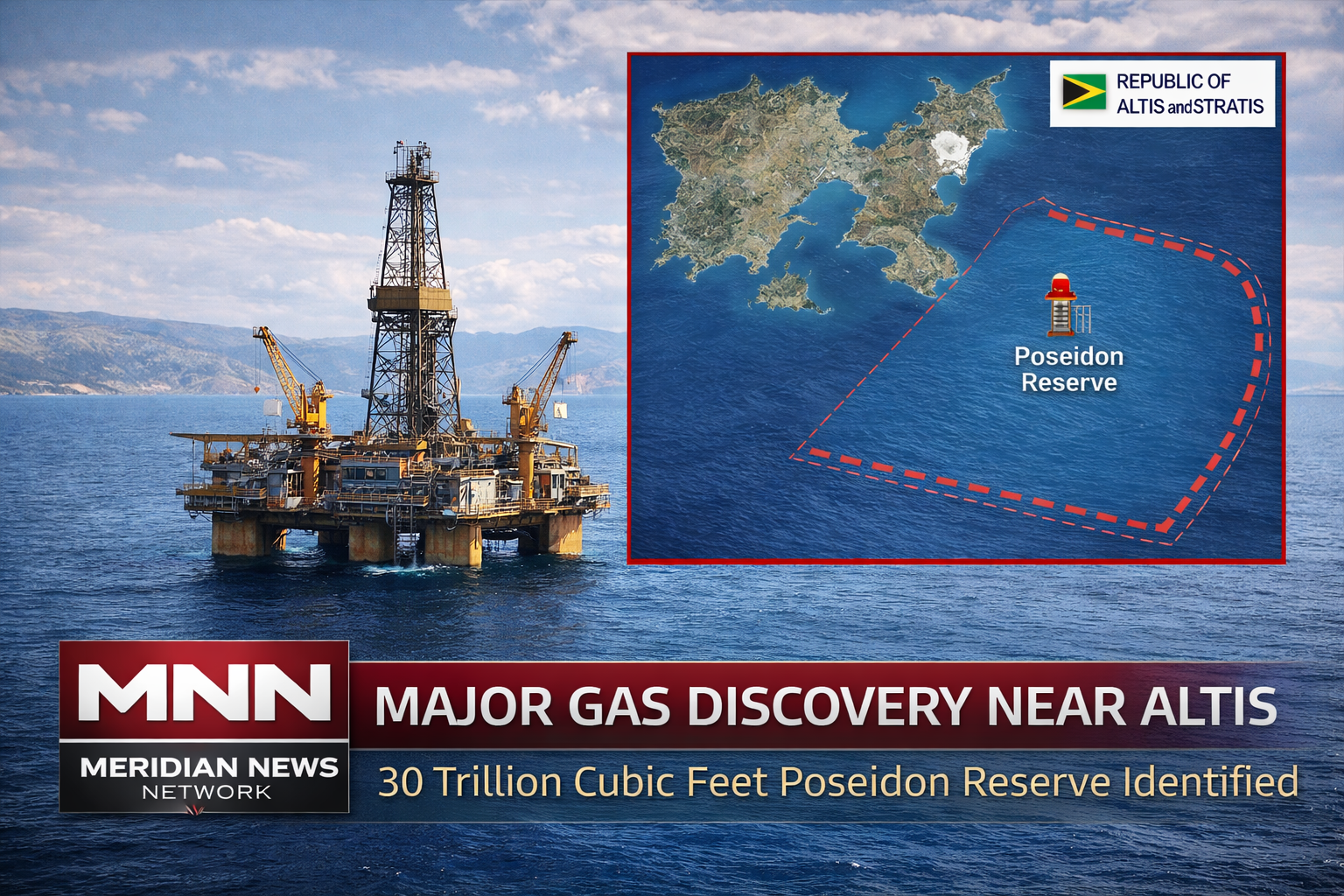
The discovery of the Poseidon Reserve positions Altis and Stratis as a major emerging energy player in the eastern Mediterranean.
Fresh Kavala Protests Signal Deepening Crisis on Altis
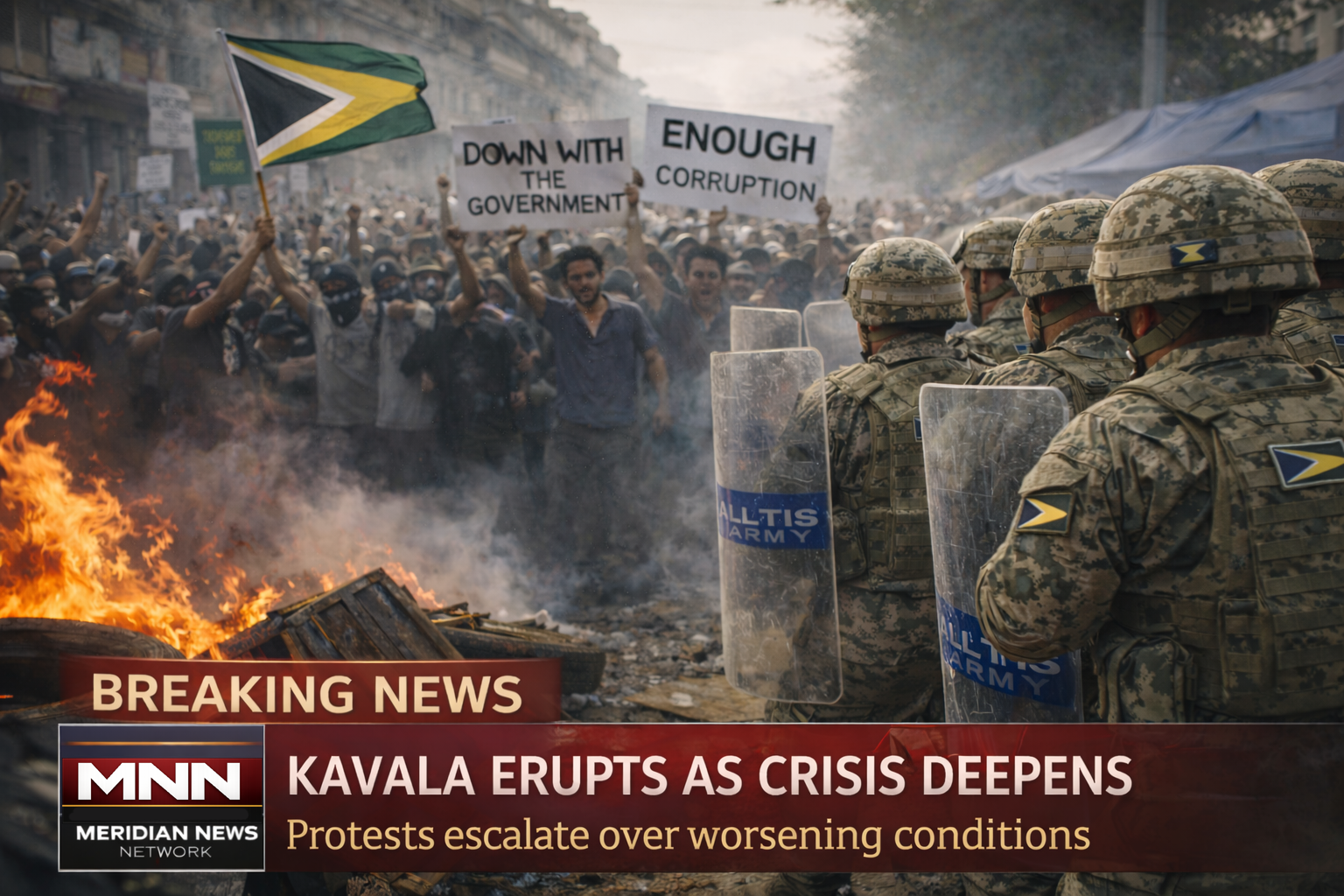
A new wave of demonstrations in Kavala underscores the continuing economic breakdown on Altis, with some marchers now appearing armed as local coverage intensifies.
Defense Ministry Signals Imminent Northwest Altis Operation
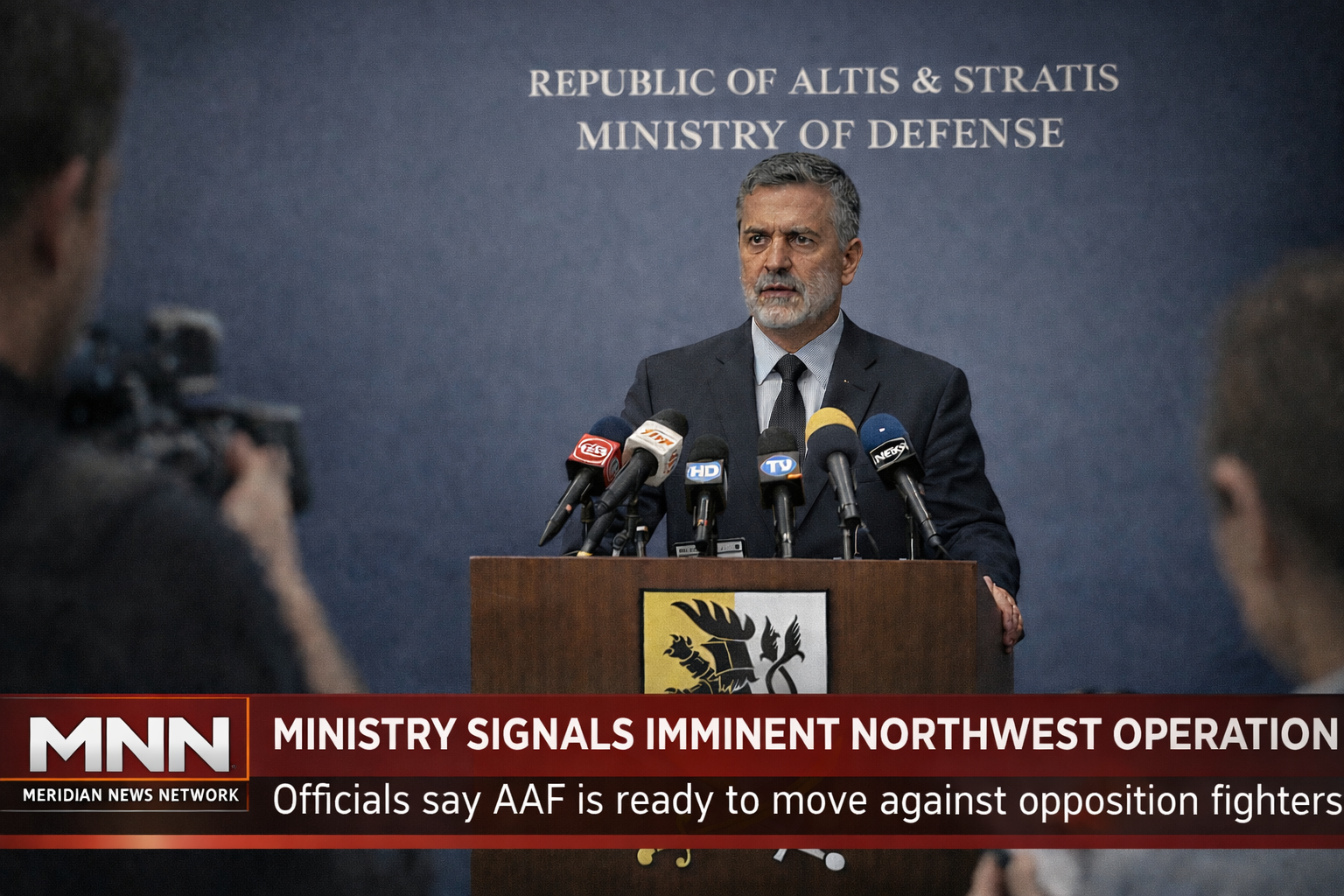
The Republic's Defense Ministry says AAF forces are preparing for operations in northwestern Altis after new intelligence reinforced concerns over armed opposition activity in the region.